
RIP Ken Nordine

Ken Nordine, Chicago creator of ‘word jazz’ who had a voice that ‘could give you the chills,’ dies at 98

By Rick Kogan

Chicago Tribune

Feb 16, 2019 at 2:00 pm

Before you read the words written below about the life and times and accomplishments of a man named Ken Nordine, who died Saturday at his North Side home at the age of 98, it would be a good idea for you to listen to whatever you can find at www.wordjazz.com.

What you will discover is the one-and-only voice of Ken Nordine, one of the few people in the history of radio to use the medium to its fullest potential, rather than as a forum for blather, confrontation, inanities and noisy nonsense. He made a kind of vocal music as the voice of thousands of commercials and as the force behind a new art form he created and called “word jazz.”

You may never have heard the Ken Nordine name, but there is no doubt you have heard him. He was often referred to simply as “The Voice,” and you will read elsewhere that he possessed “the voice of God.” As complimentary as that may be, it is hyperbole. Nordine’s voice was as distinctive as any, but it also carried a palpable and unforgettable humanity. For the Chicago Blackhawks, he gave voice to these four unforgettable words — “Cold steel on ice” — that remain firmly embedded in local minds.

Those many hockey commercials were crafted by Chicago’s Coudal Partners advertising/marketing firm through the 1990s and into the next century. Kevin Guilfoile, now a successful novelist and screenwriter (castofshadows.net), was intimately involved in the process.

“Working with Ken was a thrill and an inspiration,” Guilfoile said Saturday. “He was a one-of-a-kind master poet, performer and producer — one of those rare people with a brilliant singular vision and also the creative and technical chops to make that vision a reality all by himself. There was something so pure about his art.

“He was also a pleasure to work with. When I heard the news of his death, the first thing I did was call (firm president) Jim Coudal, and Jim said, ‘There was nothing like answering the phone when Ken called.’ That’s so true. Just hearing your name said by that voice could give you chills.”

Nordine was born on April 13, 1920, in Cherokee, Iowa, the son of Theresia and Nore Nordine. His father was an architect/builder, and some of his work sparkled along the lakefront during our 1933-34 World’s Fair. This is where the family settled and where Ken attended what is now Lane Technical College Preparatory High School and the University of Chicago.

He started work in 1938, making $15 a month running a mimeograph machine at the studios of WBEZ, when that radio station programmed exclusively for the public schools. He then moved on to announcing jobs at stations in Florida and Michigan before returning here to become a staff announcer for WBBM-FM and to start making radio commercials.

One writer described his voice as an instrument that “muses and oozes like molten gold.”

In 1945, he married Beryl Vaughan, also a talented voice artist on such old radio program as the “Lone Ranger” and, for a time, was a Hollywood actress.

They settled into a home on the North Side and raised three sons.

“My father loved Chicago, deeply,” said his eldest son, Ken Jr., who worked for many years as an engineer and producer alongside his dad. “He was ever turning down opportunities to work in New York or Los Angeles.”

As successful as Nordine’s announcing and commercial work was, he was creatively restless and drawn to more adventurous vocal avenues. One night in 1956, he was reciting the poetry of T.S. Eliot and Edgar Allan Poe for musicians Johnny Frigo and Dick Marx at a Wilson Avenue club called the Lei Aloha. He ran out of poems and started to improvise. Thus was born what he called “word jazz,” a concept that would go on to spawn a dozen record albums, a syndicated radio show and make him a legend.

In 1990, Nordine accepted an invitation from Jerry Garcia and the Grateful Dead to perform with them at a New Year’s Eve concert. He would also collaborate with David Bowie, Tom Waits and many others in a late-life career that compelled one writer to call him “an underground hipster for the ages.”

None of this went to his head. “He was just the loveliest guy,” Guilfoile said. “And surprisingly for someone of his generation, he was fascinated with new processes and technology.”

Shortly after celebrating his 85th birthday with a party at the Chicago Yacht Club in 2005, he sat in his home and excitedly showed off his brand-new DVD, his first. It was titled, “The Eye is Never Filled,” a phrase that he remembers his mother saying to him repeatedly when he was very young. He told me then, “This is word jazz in morphing pictures” and described it as something that “looks like it was done under the influence of LSD.”

Nordine lost his wife in 2016 and 18 months ago suffered a stroke. “That kind of inhibited his ability to create,” said Ken Jr. “He was no longer able to use a computer, but he kept modestly active. He just slowed down a bit.

“You hear so much about my dad’s special voice, but the thing was he knew how to use it. He also had such a special mind that enabled him to deconstruct the world and put it back together in the most compelling ways.”

Those ways are still, and ever, available, at wordjazz.com, and he is also survived by sons Kristan, a musician, and Kevin, a filmmaker; 10 grandchildren; and four great-grandchildren. A memorial service is being planned.

rkogan@chicagotribune.com

Best of 2018

Close to the Noise Floor compilation

Noise Reduction System compilation

Third Noise Principle compilation

Brian Eno – Music for Installations

Cocky Bitches – Mercy

Jon Spencer – Sings the Hits

Baba Commandant – Sira Ba Kale

Sujud – Semyawa

Alice Cooper – Brutal Planet

John Coltrane – Lost Album

Animal Collective – Tangerine Reef

Hardy Fox – American Composer 1945 – 2018

Hardy was best known (or rather unknown) as the main composer for The Residents. Just take a look at this discography and you will see it is undeniable that he lived his life as a composer. The Residents are among the small few that have had great impact on my life not only as a musician but as a music lover and performer. They exposed me to music that was outside the box. They exposed me to art that was outside the box and they exposed me to the truth of great art, which is that it must be done.

Who knows was the future holds? If he was like Zappa, maybe there is a storehouse of compositions waiting to be unleashed. Whatever the outcome, I will miss getting an announcement that there is a new Hardy Fox composition to listen to.

He did it! He made it through life as an artist and that is truly an accomplishment.

Facebook Reality Labs

Now I can point to this article to inform people about what I do for a living.

They say that seeing is believing, but at OC5, Oculus Chief Scientist Michael Abrash made the case that accurate sound rendering plays a critical role in creating believable VR experiences-and a key part of sound rendering is simulation of the environment and its acoustics. In their Oculus Connect talk entitled “Spatial Audio for Oculus Quest and Beyond,” Audio Design Manager Tom Smurdon and Software Engineer Pete Stirling discussed how to create high-fidelity audio experiences for Oculus Quest and Rift and shared details on some future technology coming to the Audio SDK. Today, we’re excited to share a behind-the-scenes look at the work being done at Facebook Reality Labs to inform those new advances.

Perceiving the Problem
When sound is produced in the real world, it interacts with the environment in a complex way. The vibrations of an object cause sound pressure waves to propagate through the air, where those waves are scattered by surfaces like walls, floors, and ceilings. This changes the sound before it reaches our ears. The sound we hear is really the sum of many echoes of the original source that arrive from different times. If the source is visible, the first sound we hear is the direct sound, which travels along the shortest path from the source to the listener. Next, sound that has reflected off of nearby surfaces will arrive at the listener from various directions. These are called early reflections. The remainder of the sound is reverberation, which consists of a buildup of many delayed echoes that decay smoothly over time.

Until recently, most audio rendering systems for VR and games have only rendered the direct sound component accurately. Yet surprisingly, there’s usually far more reflected and reverberant sound energy in most rooms than there is from the direct sound. To get more realistic audio, a sound designer would have to manually add reverb zones to every location in a virtual environment. This is a time-consuming process that requires a lot of parameter tweaking, manual effort and expertise to get good results.

At Facebook Reality Labs (FRL), we’ve been working over the last year to create high-quality acoustic simulation technologies that can automatically generate reflections and reverberation based on an environment’s geometry. Today, we want to share how researchers on the audio team at FRL have approached this problem.

Meet the Researchers
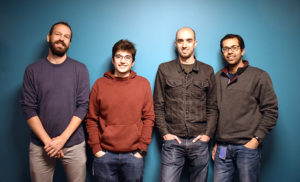
Facebook Reality Labs Audio Research Team (L-R): Philip Robinson, Sebastia V. Amengual Gari, Carl Schissler, and Ravish Mehra
When Research Team Manager Ravish Mehra started the audio team at FRL four years ago, he envisioned creating a VR world where the virtual audio is perceptually indistinguishable from real-world audio. He knew the first order research problems that he would have to tackle to achieve this future would be high-quality spatial audio and efficient room acoustics. Over the next few years, he started a large research effort to solve the spatial audioproblem while looking for the right person to join his team to solve the room acoustics problem.

“Solving the room acoustics problem is extremely computationally expensive, and I knew that accurately simulating the acoustics of the environment would not be enough,” Mehra says. “Any approach we came up with would need to satisfy the tight computational and memory constraints imposed by real-time VR applications.”

A unique opportunity arose in summer 2017 when Carl Schissler finished his University of North Carolina at Chapel Hill doctorate on that very same topic. Schissler had completed two summer internships on the FRL audio team with Mehra as his intern mentor and was a perfect fit for the open-room acoustics lead researcher role.

“When I started at Facebook Reality Labs last year, I was given the task of creating a system that could simulate all of these complex acoustics in real time,” Schissler explains. “I’ve wanted to create better audio for games since I was very young. Back then, I would modify my favorite games by adding reverb to the sound effects in an effort to make them more atmospheric. Now, years later, I’m thrilled to have the opportunity to work on this technology that has the potential to have a huge impact on sound quality in VR.”

The FRL audio team’s psychoacoustics group led by Research Science Manager Philip Robinson also played a key role in the project. Postdoctoral Research Scientist Sebastià V. Amengual performed experiments to determine which aspects of the acoustic simulation were most important to simulate accurately. With a solid psychoacoustic foundation, the FRL audio team was able to do perceptual evaluation of new audio technologies to inform future development.

Computational Challenges
The biggest obstacle to realistic simulation of acoustics is the computational complexity involved. There are a number of different existing simulation techniques based on numerical wave solvers or geometric algorithms, but none of them are efficient enough to run in real-time on current hardware. A fast multicore CPU or GPU would be required to make previous approaches run fast enough, and even then they would only be able to simulate a handful of sources at a time. Add in a game engine doing all kinds of graphics, physics, AI, and scripting at the same time, and you can see how difficult it is to get the necessary amount of resources.

The typical way to sidestep this problem is to do a long precomputation to simulate the acoustic responses for every pair of listener and source locations. At runtime, the response for each source can be interpolated from that data and used to filter the source’s audio. In practice, this adds up to a huge amount of data for non-trivial scenes. Another drawback is that, since all of the acoustic responses are precomputed, there cannot be any dynamic scene elements that change the sound. This means that shutting a door won’t stop you from hearing a sound source, and destructible or user-created environments are totally out of the question.

At FRL, our challenge was to develop an approach that was able to render high-quality audio for complex scenes while using as few compute and memory resources as possible. The bar was high-typical games may have hundreds of concurrent sound sources that need to be simulated, and the compute budget is extremely tight. Furthermore, the simulation needed to be dynamic so that it could enable the widest range of immersive audio experiences, unburdened by long precomputation times.

Sound Innovations
To solve this challenge, Schissler spent almost a year perfecting the simulation engine. “I had to leverage every trick and optimization I could think of to build a system with the required capabilities,” he notes.

To efficiently compute the propagation of sound within a 3D environment, the researchers made use of an advanced ray tracing algorithm. Traditional acoustic ray tracing would require tracing many millions of rays per second, necessitating a large amount of computation. Optimizations developed by Schissler allowed the number of rays to be greatly reduced while maintaining high quality and enabling dynamic scene elements. The largest issue when using stochastic ray tracing is the presence of noise that can lead to audio artifacts. In order to deal with this, the researchers developed clever noise reduction algorithms to filter out the noise in the simulation results.

Another big problem came about when the number of sound sources in the scene grew large. In a naive implementation, the computation time would increase in proportion to the number of sources. One of the key developments that makes the new technology feasible is a perceptually driven, dynamic prioritization and source clustering system. By developing smart heuristics that are able to cluster unimportant or distant sources together, the researchers have been able to dramatically reduce the computation time in very complex scenes.

When You Hear It
Using the innovations developed at FRL, the researchers were able to meet the initial goals of the project and deliver a working prototype to the Oculus Audio SDK team led by Spatial Audio Tech Lead Robert Heitkamp. At OC5, Audio Design Manager Tom Smurdon and Software Engineer Pete Stirling presented this system in action. During their talk, Smurdon, a veteran of the game audio industry, gave his opinion on the prototype: “You will know when you’re next to a wall without even seeing anything. You can feel everything-it’s amazing. I’m super enthused and happy about where they are at right now”.

“When you hear a realistic audio simulation for the first time in VR, it’s almost uncanny how much it enhances immersion,” adds Schissler. “Authentic audio rendering can even synergistically help make visuals seem better.”

Creative Freedom
One of the main goals the team had when developing this tech was to empower sound designers and make it easy for them to create realistic audio experiences in VR. They also wanted to provide artists with parameters to help them achieve their creative visions. “Sometimes you don’t want things to sound 100% realistic,” says Schissler. “During dialogue, you might want to lower the amount of reverberation to make sure the characters are understandable. This new tech has that level of flexibility.

Now, instead of designers having to setup reverb zones with a complex set of parameters for every room, they only need to assign material properties to the geometry. The dynamic nature of the simulation also benefits content creators-artists can tweak parameters while the simulation is running, greatly reducing iteration times compared to precomputed acoustic simulations.

Future Sounds
Now that the FRL audio team has achieved their goal of developing an efficient simulation engine, they’re focusing their efforts on improving the technology to simulate additional acoustic phenomena. There are many acoustic phenomena that are difficult to simulate, such as diffraction, transmission, and standing waves. The next steps are to research new methods to compute those effects efficiently. “I hope that we can continue to push forward the state of the art in audio,” says Schissler. “I’m excited for the time when all games have this level of audio fidelity.”

In his OC5 keynote, Michael Abrash described the problems that must be solved in order to generate authentic audio for VR and AR. In addition to simulation of room acoustics, another challenge in spatial audio is the personalization of head-related transfer functions (HRTF), by which audio can be generated in a way that the 3D spatial cues are tailored to each individual. Abrash explained that HRTF personalization is a problem that may take longer than expected to solve. On the bright side, including acoustic simulation of the environment may help to improve immersion until practical HRTF personalization can be realized.

– The Oculus Team